
Writer: Lauren El Solakhy
Date: December 5, 2025
Article Title:
Ocean alkalinity enhancement through restoration of blue carbon ecosystems
Article Affiliation:
Department of Earth and Planetary Sciences, Yale University; School of Earth and Atmospheric Sciences, Georgia Institute of Technology
Article Citation:
Fakhraee, M., Planavsky, N. J., & Reyes, C. T. (2023). Ocean alkalinity enhancement through restoration of blue carbon ecosystems. Nature Sustainability, 6, 1087-1094.
INTRODUCTION
One of the most promising natural solutions for combating climate change is through the utilization of blue carbon ecosystems (BCEs), such as mangroves and seagrasses. These ecosystems not only sustain marine life but also enhance the ocean’s ability to absorb and store carbon dioxide (CO₂), thereby reducing its concentration in the atmosphere.
The research presented in the article “Ocean Alkalinity Enhancement through Restoration of Blue Carbon Ecosystems” investigates how restoring these ecosystems can enhance ocean alkalinity and, subsequently, carbon storage. The authors employed advanced biogeochemical modelling techniques to evaluate the potential of BCEs as effective tools for mitigating climate change. The focus of this study is to assess how BCE restoration can bolster the ocean’s capacity for long-term CO₂ removal.
RESULTS AND DISCUSSION
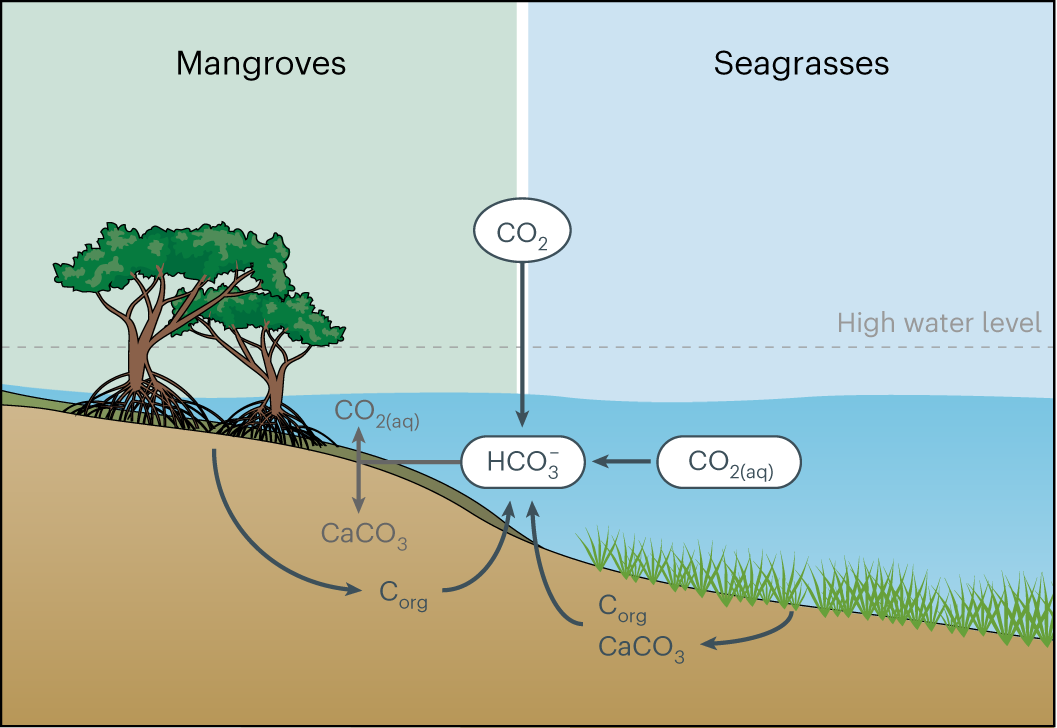
The study utilized biogeochemical simulations to evaluate the effects of restoring BCEs on oceanic carbon storage. Although BCEs cover only a small fraction of the ocean floor (approximately 0.5%), they play a disproportionately significant role in carbon sequestration by burying large amounts of carbon in marine sediments. The restoration of BCEs enhances the production of bicarbonate (HCO₃⁻) through anaerobic processes such as sulfate reduction, which subsequently increases ocean alkalinity and stabilizes pH, making the ocean more efficient in absorbing CO₂.
In carbonate-rich environments—including regions like the Bahamas and the Red Sea—BCE restoration further promotes the dissolution of calcium carbonate (CaCO₃) in sediments, thereby boosting ocean alkalinity and CO₂ absorption even more effectively. The simulations estimate that restored BCEs have the potential to sequester between 0.1 and 17 tons of CO₂ per hectare per year, contingent upon local environmental variables such as temperature and sediment composition.
The study further highlights the resilience of BCEs under challenging environmental conditions, such as increased ocean acidity and elevated temperatures. Despite these adverse conditions, restored BCEs continue to produce alkalinity and act as reliable carbon sinks, underscoring their value as a sustainable climate mitigation strategy. Furthermore, BCE restoration yields broader ecological benefits: it stabilizes coastal sediments, reduces erosion, mitigates the impacts of storm surges, and supports biodiversity by providing habitats for numerous marine species. This multifaceted resilience makes BCEs indispensable in the face of ongoing climate challenges.
However, the costs associated with restoring these ecosystems—particularly seagrass—can be substantial, reaching up to 100,000 USD per hectare due to the labor-intensive nature of restoration and the ongoing maintenance required. Nevertheless, the economic benefits from carbon credits generated through CO₂ removal could significantly offset these costs. With a nominal carbon price of 100 USD per ton of CO₂, the value derived from alkalinity-based carbon sequestration could make the restoration of BCEs financially feasible and even profitable, contributing not only to environmental health but also to economic sustainability.
CONCLUSION
In conclusion, the findings of this research demonstrate that restoring blue carbon ecosystems presents a natural and highly effective solution for mitigating climate change. By enhancing ocean alkalinity, BCEs offer a durable method of carbon storage, which contrasts favorably with traditional approaches that are often prone to CO₂ re-release. Beyond their role in carbon sequestration, BCEs significantly improve coastal resilience and foster marine biodiversity, positioning them as vital components of comprehensive climate mitigation strategies. Integrating BCE restoration into global climate action plans could yield substantial environmental and economic benefits, contributing meaningfully to a more sustainable and climate-resilient future.
Leave a Reply