
Author: Tomas Wang
Date: October 7, 2025
Area of Impact:
Atlantic Canada
Article Information and Location:
The issue isn’t the carbon tax — it’s climate change
Aaron Wherry, CBC News, Sep 21st, 2024
INTRODUCTION
As the human race progressed out of the primitive age, we developed and established the idea of governments — a group that rules over a body of people and regulates society. Governments take on many roles, which may include preventing chaos between their citizens, improving society for the better, and working to exterminate external threats. However, all of that requires one thing — money. To combat the great cost of running a government, the idea of taxation was developed, which takes a percentage from the earnings of the working citizens and uses it toward running the government and improving society. As time elapses, taxes become complicated, and it takes a professional to explain the ins and outs. However, there is a component of the Canadian tax system that has been getting much attention lately. It is the one and only: Carbon tax.
Carbon tax, or carbon pricing, is a very complicated business. For the sake of simplicity, it will not be covered thoroughly in this article. The only thing noteworthy is that the carbon tax is utilized by the Canadian government to combat climate change, and people have been questioning whether it is worth it. The article The issue isn’t the carbon tax — it’s climate change details the stances taken by the New Democratic Party and Conservative leaders and discusses the flaws in their arguments. The article is categorized as an analysis article and argues against the NDP and the Conservative Party. The existence of conformational bias (cherry-picking) is possible. Please proceed with caution.
Taken from The Hill Times
INFORMATION AND SIGNIFICANCE
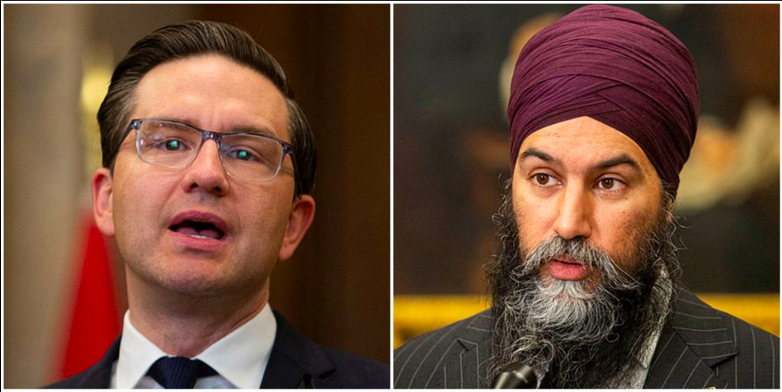
Many of the parties opposing the Liberals oppose the carbon tax. The article mainly discusses the NDP and the Conservative Party. The NDP leader, Jagmeet Singh, spoke recently in Montreal about his take on the carbon tax. He disagreed with the government’s new policy of taking home-heating oil out of the federal fuel levy and he made a statement about carbon tax as a whole: “[New Democrats] want to see an approach to fighting the climate crisis where it doesn’t put the burden on the backs of working people.” Interestingly enough, the NDP originally supported the carbon tax. Their change in attitude is possibly caused by the threat of the Conservative Party.
The Conservatives have traditionally opposed the carbon tax. The Conservative leader, Pierre Poilievre, spoke more about his stance on the issue. His stance was quite clear, as he utilized phrases like “mass hunger and malnutrition”, “shut down our entire economy”, “nuclear winter”, “[Trudeau’s] crazy carbon tax obsession”, and “existential threat to our economy and our way of life”. As a matter of fact, the Conservatives have been against the idea of a carbon tax even before it was implemented.
However, there are quite a few flaws in the arguments of these political leaders. First is the fact that the information used by Poilievre doesn’t give the full picture. He detailed in the interview that the carbon tax will cost Canada $25 billion by 2030. However, that doesn’t take into account the expected Canadian GDP of $2.688 trillion, which would barely be changed by $25 billion. Even that ignores the fact that the study he referenced doesn’t consider the benefits that the carbon tax would bring.
Both political leaders also failed to provide an alternative to the carbon tax. Clearly, climate change can’t be left untreated, but the carbon tax seems to be the only solution until the political parties come up with a plausible alternative. Lastly, the party leaders also didn’t take into account the fact that as much as 90% of the carbon tax is given back to Canadians. In fact, low-income families actually made a profit from the carbon tax.

The significance of the carbon tax is quite obvious. It is actively taking away our earnings and using them to help the failing environment. Both parts of the previous sentence are awfully important, with the first part being perhaps more meaningful to the general Canadian. Though the significance of the latter is also something we can’t ignore. It is also important to understand that we live close to great change within our country.
CONCLUSION
The carbon tax stands as one of the great controversies of Canada in the present time; some people love it, some people hate it, and political leaders have varied opinions on this issue. It is important to learn the arguments of the leaders and decide on who to support. Nevertheless, this inquiry has to be done in an environment where the arguments of the political leaders are checked for misinformation. This original article was perhaps written by Aaron Wherry for this exact reason. However, as mentioned in a previous paragraph, the information present in this article summary and the original article may be one-sided. In the spirit of anti-misinformation, it is also encouraged that you, the reader, do some research of your own before making up your mind on the issue.
Leave a Reply